Folks often ask what is the proper suspension spring. Not just for modern German movements but for movements in general. Aside from using what is the factory original, the simple answer from a technical view, is the lightest spring that will still support the weight of the pendulum.
The reason for this is that a spring that is stronger or stiffer than it needs to be will alter the natural rate of the pendulum and also require more force needed to drive the clock. Ideally, there would be not suspension spring at all. Such is the case in the highly accurate units using a knife edge suspension.
The suspension springs that come with the new movements are, in my opinion, way too strong. The reason for this was the request years ago by the sellers such as Miller and Sligh to use a suspension spring strong enough that the customer could not break it. In my view, it should be about half that strong, or less, in the grandfather clocks and I often suggest filing away 50% of the spring.
A spring that is too thick will also cause a clock to run faster, sometimes significantly so, than it normally would. The flexing of the spring also alters the effective length of the pendulum to be shorter.
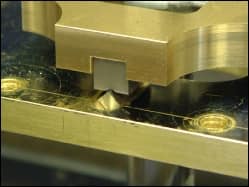
Shown left is the picture of an interesting set up. This is what I term an inverted knife edge. In this unit, the knife edge is at the bottom and the block is at the top attached to the pendulum. The pendulum itself is not part of the picture and only the very top of the pendulum is shown. In most cases, the knife edge is part of the pendulum and the block is at the bottom but the result is the same.
If you look closely the block has a shallow ‘V’ cut into it to keep the knife edge in place.