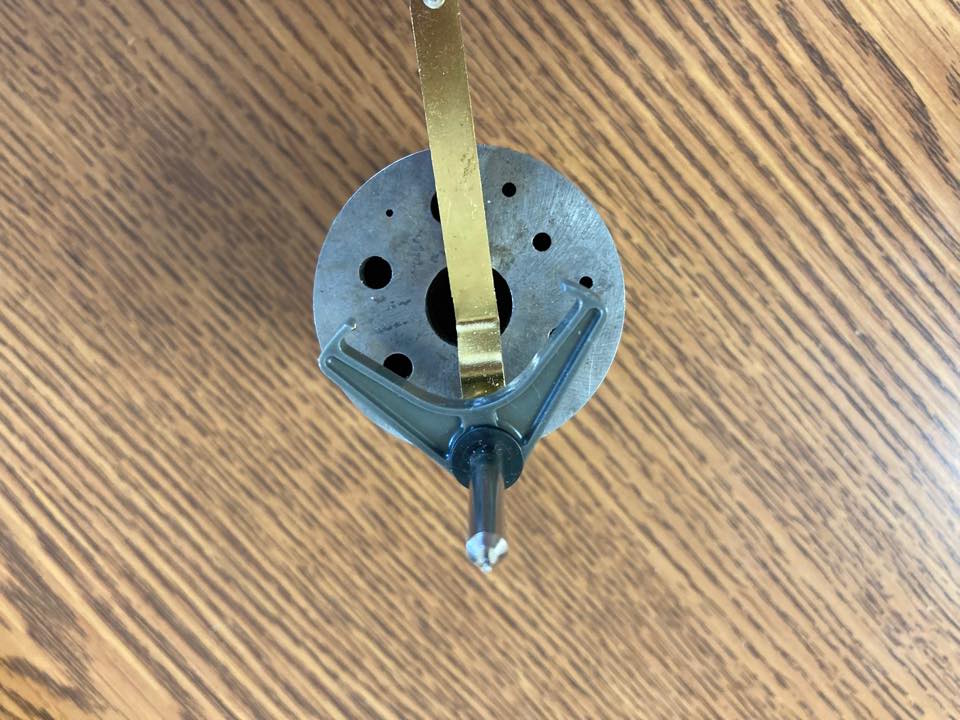
For the past 10 years or so, Kieninger has used a revolutionary type of pallet material. It is glossy like plastic, but in fact it is 10 times harder than steel and is ceramic. In addition, it is extremely low in friction. Although we still recommend lubrication with 859 oil, the claim is made that this pallet will actually operate without lubricant. As seen in this photo, it is cast in a sense.

This photo shows it actually working in an MSU unit. We have these verges complete available. Kindly specify the movement into which it goes.
REPAIR TIP:
Nearly everyone has had a Hermle balance wheel movement come across the bench. First, let me say that there are only THREE beat rates:
+ Large balance in 350 and1050 series 9,000 bph
+ Small balance in 130 series 10,800 bph
+ Swiss escapement in 132 series 18,000 bph
Having said that, in watchmaking terms the large and small balances are examples of what is known as a pin pallet escapement. This escapement is 80% less efficient than the corresponding pendulum escapement for the same movement. In other words, only 20% as much power actually gets transmitted to the timing mechanism.
Most of the Hermle balance movements have a pendulum counterpart that I suggest you consider. They are far less troublesome and far easier to adjust.
340-020 becomes 341-020/11 cm
350 and 1050 series become 351
1051 in 15 cm
Nearly every clock case has room for the pendulum execution. In our own shop we replace all balance clocks with pendulum ones.
All Hermle pendulum units have the beat rate in bpm stamped on the back plate. To get bph multiply by 60.